
Honored to be one of the Top Construction Engineering Management Firm 2025 by Construction Business Review. Click Here Honored to be one of the Top Construction Engineering Management Firm 2025 by Construction Business Review. Click Here Honored to be one of the Top Construction Engineering Management Firm 2025 by Construction Business Review. Click Here Honored to be one of the Top Construction Engineering Management Firm 2025 by Construction Business Review. Click Here Honored to be one of the Top Construction Engineering Management Firm 2025 by Construction Business Review. Click Here
Loading animation

“For every project there is a story
that we narrate”

Pearls Blog

Beyond the Model: Why “2D Thinking” is Costing You Millions in a 3D World

Beyond THE MODEL

The Illusion of Certainty

Defining 4D Bim modeling services

Defining the 4D BIM Modeling Services

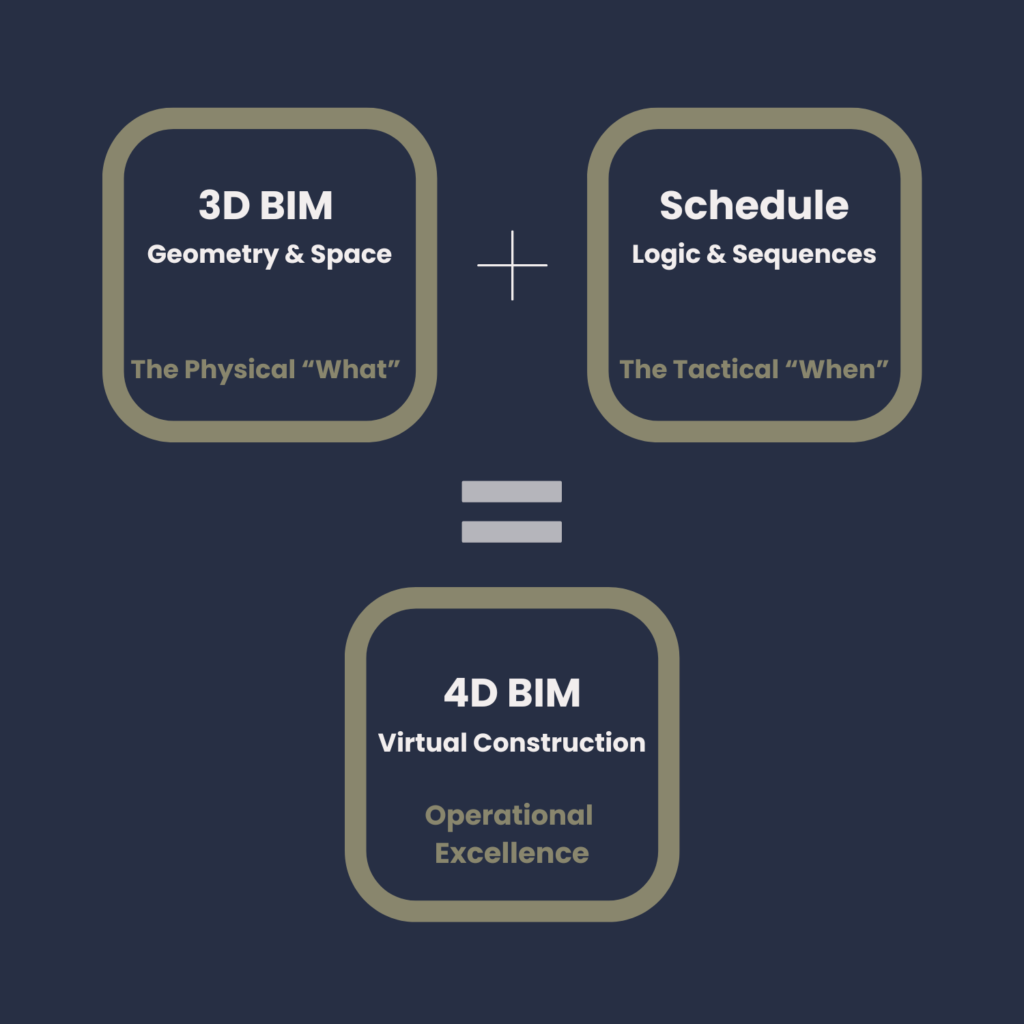
At its core, construction is a logistical ballet performed with heavy machinery and expensive labor. 2D drawings define the stage. 3D models define the set pieces. But the schedule for the P6 or MS Project Gantt charts the choreography.

Traditional planning keeps the choreography separate from the set pieces. We have a 5,000-activity schedule on one screen and a Navisworks model on another, and we rely on the human brain to mentally merge them. This is a recipe for errors.

4D BIM is the mathematical linkage of these two worlds. By linking activity IDs from the schedule to element IDs in the model, we transform a static picture into a dynamic simulation. We stopped looking at a building and started watching the construction.

The Silent Killer: Temporal Clashes

The industry has enthusiastically adopted BIM for “clash detection.” We run algorithms to ensure an HVAC duct isn’t trying to occupy the same physical space as a structural beam. This is valuable, but it only solves “hard” clashes problems of geometry.

The far more expensive problems are “soft” clashes, or more accurately, Temporal Clashes, a temporal clash occurs when the schedule logic looks sound on paper, but the physical reality is impossible.

For example:
The schedule shows the electrical rough-in starting on Monday in Corridor A.
The schedule also shows the drywall crew finishing framing in Corridor A on Monday.

In a 2D Gantt chart, these two bars might just sit peaceably next to each other. In a 3D model, you just see the finished hallway. But in a 4D BIM Modeling Services, you immediately see the disaster: two different trades, with their materials, ladders, and tools, fighting for the same 200 square feet of workspace.

The result in the field is immediate productivity loss. One crew stands around waiting (burning cash), or worse, they work on top of each other, creating safety hazards and quality issues. 4D BIM Modeling Services exposes these logistical nightmares months before mobilization, allowing the Planning Engineer to re-sequence the work in the digital world rather than fighting fires in the physical one.

A chart that showing how clashes kill projects
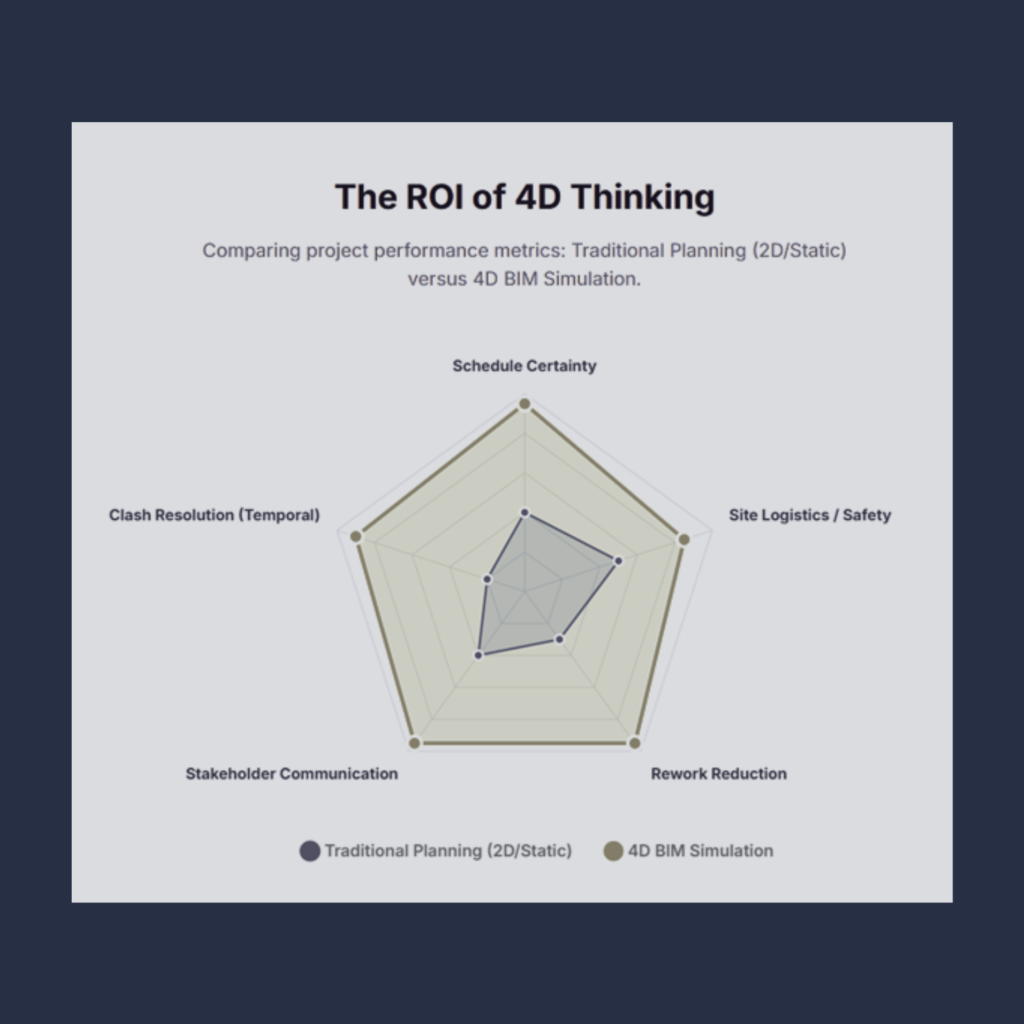
Explanation of the ROI of doing 4D Bim modeling services

The ROI of 4D BIM Modeling Services

Moving from 2D thinking to 4D simulation is not just about making cool animations for client presentations; it is hard-nosed by risk mitigation and financial protection. The return on investment comes from three critical areas:

1- Validating the Schedule Logic: We often build schedules based on theoretical production rates. A 4D playback serves as the ultimate “stress test” for our logic. Does the sequence of steel erection make sense with the crane position? Are we closing walls before bulky equipment has been moved inside? Watching the sequence reveal itself visually often highlights logical flaws that are invisible in a list of dates.

2- Site Logistics and Safety Planning: On tight urban sites, the laydown area is prime real estate. A 4D model can simulate the delivery schedule, showing exactly where materials will be staged phase by phase. More importantly, it can simulate major equipment movements—like crane swing radio to ensure that we don’t have overlapping danger zones during peak operational hours.

3- Radical Transparency in Communication: Trying to explain a complex phasing sequence to an owner using a 100-page PDF schedule is an exercise in futility. Showing them a 60-second video where the site evolves color-coded by month is instant clarity. When stakeholders can see the plan, buy-in increases, and change order disputes decrease.

Conclusion: The Planner’s Evolving Role

The adoption of 4D BIM changes the role of Planning Engineer. We are no longer just historians recording delays or data-entry clerks updating percent-completes. We become virtual construction managers.

We build the project digitally first, fail, learn, and optimize it in a risk-free environment, so that when the real crews arrive on site, the path to execution is clear. In today’s complex construction market, if you aren’t planning in 4D, you aren’t managing the project; you are just waiting for the next expensive surprise.

Newsletter Popup

Thank You!

You've successfully subscribed to our newsletter.

×