


Pearls Blog
The Impact of Planner Experience and Decision-Making on Schedule Reliability in Construction Projects
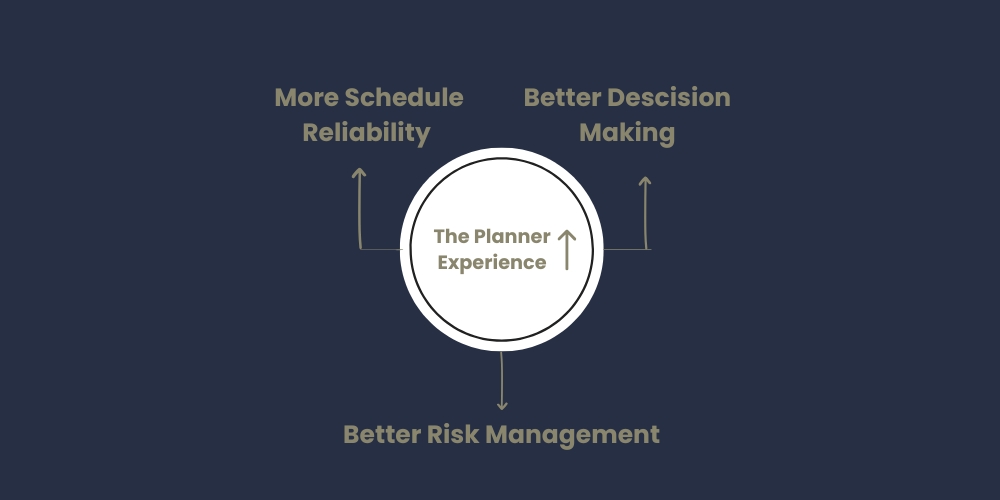
Impact of Planner Experience to Schedule Reliability
introduction
Schedule reliability is a cornerstone of successful construction project delivery. Reliable schedules support effective decision-making, cost control, resource allocation, and stakeholder coordination. Despite advancements in scheduling software and industry standards, many projects continue to experience delays and schedule instability.
A key contributing factor is often overlooked: the experience and decision-making capability of the construction planner. Beyond tools and methodologies, it is the planner’s professional judgment that ultimately determines whether a schedule is realistic, resilient, and reliable.
Understanding Schedule Reliability
Schedule reliability refers to the degree to which a project schedule accurately predicts actual project performance over time. A reliable schedule reflects realistic activity durations, logical sequencing, credible critical paths, and achievable milestones.
It is not static; reliability must be maintained through continuous updates and informed forecasts. When schedules fail to reflect field conditions or evolving risks, they lose their value as management tools and become reactive reporting instruments instead.
The Planner’s Role in Construction Scheduling
The construction planner serves as the link between project strategy and execution. This role includes developing the baseline schedule, maintaining updates, analyzing impacts, and communicating schedule status to stakeholders. Effective planners must synthesize information from design teams, construction managers, subcontractors, and external agencies.
Planner responsibilities extend beyond technical scheduling tasks. They must understand construction means and methods, contract requirements, sequencing constraints, and interfaces between trades. Without this contextual understanding, even a well-formatted schedule may lack constructability and realism.
Influence of Experience on Schedule Logic and Sequencing
Planner experience has a direct impact on the quality of schedule logic. Experienced planners are better equipped to develop sequences that reflect how work will be performed in the field. They recognize the importance of access constraints, work zones, crew flow, inspection hold points, and temporary work.
Inexperienced planners may rely heavily on generic templates or theoretical sequencing that ignores site-specific conditions. This often results in overly optimistic logic, excessive concurrent activities, or unrealistic assumptions regarding trade availability. Such schedules may appear compliant at submission but quickly lose credibility during execution.
Experienced planners also avoid common logic deficiencies, such as redundant relationships, excessive use of constraints, or inappropriate leads and lags. These technical decisions directly influence the accuracy of the critical path and total float calculations.
Duration Estimation and Productivity Assessment
Accurate duration estimation is fundamental to schedule reliability. Planner experience plays a significant role in assessing realistic production rates and activity durations. Veteran planners draw on historical data, lessons learned, and firsthand knowledge of similar projects to calibrate durations appropriately.
Less experienced planners may underestimate durations by assuming ideal conditions or by applying generic productivity rates without adjustment for site constraints, learning curves, or weather impacts. Overly aggressive durations often lead to frequent revisions, eroding stakeholder confidence in the schedule.
Decision-Making in the Presence of Risk and Uncertainty
Construction projects are inherently uncertain. Design development, utility conflicts, permitting delays, and third-party approvals introduce risks that must be addressed during planning. Planner decision-making determines how effectively these risks are modeled within the schedule.
Experienced planners proactively identify risk-driven activities and incorporate mitigation strategies, such as contingency allowances, alternative sequencing, or risk-based logic. They also document assumptions clearly, enabling transparency and informed decision-making.
Poor decision-making—such as ignoring known risks, compressing critical activities without analysis, or failing to adjust logic as conditions evolve—undermines schedule reliability and increases the likelihood of disputes and claims.
Impact on Schedule Updates and Forecast Accuracy
Schedule reliability depends heavily on disciplined and accurate updates. Experienced planners understand that updating a schedule is not a mechanical process. It requires reassessing remaining durations, logic, and constraints based on actual performance and current conditions.
Rather than simply shifting activities to the right, experienced planners analyze the reasons behind variances and adjust forecasts accordingly. This approach improves the accuracy of completion projections and provides early warning of potential delays.
In contrast, inexperienced updating practices often mask underlying issues, resulting in delayed recognition of schedule impacts and limited opportunity for corrective action.
Communication, Reporting, and Stakeholder Alignment
Effective communication is essential to maintaining schedule reliability. Experienced planners present schedules with clear narratives, milestone explanations, and critical path summaries that are accessible to both technical and non-technical stakeholders.
By clearly explaining assumptions, risks, and drivers, planners facilitate alignment among owners, contractors, and subcontractors. This shared understanding supports realistic expectations and collaborative problem-solving. Poor communication, however, can lead to misinterpretation of schedule data, unrealistic demands, and loss of trust.
Pearls Implications and Skill Development
Pearls care and prioritize schedule reliability in the projects we work on, that’s why pearls invest in training, mentoring, and developing pearls’ planning engineers to ensure the quality of service we provide of our client’s projects.
Conclusion
The reliability of a construction schedule is not solely determined by software capabilities or formal compliance with scheduling standards. It is fundamentally shaped by the experience and decision-making quality of the planner. Experienced planners apply professional judgment, anticipate real-world constraints, manage uncertainty, and communicate effectively with stakeholders.
By recognizing and investing in planner expertise, construction organizations can achieve more reliable schedules, improved predictability, reduced risk, and stronger project performance overall.